

Table of Contents
Florida Keys Shore Fishing Rigs: Simple Setups for Snapper, Jacks, Barracuda and More
Florida Keys shore fishing rigs do not need to be complicated.
For most visitors fishing from bridges, beaches, piers, seawalls, or public shoreline access, a handful of basic rigs will cover a surprising amount of fishing.
You do not need twenty different setups.
You need a rod that can handle saltwater, leader material, hooks, a few sinkers, and a basic idea of what you are trying to catch.
The best rig changes with the water.
A rig for mangrove snapper beside a bridge piling is different from what you might throw across a shallow flat.
And neither setup is what you would want for a large tarpon or shark.
This guide covers practical Florida Keys shore fishing rigs you can put together without hauling an entire tackle shop on vacation.
What Is the Best Florida Keys Shore Fishing Rig?
There is no single best rig.
If you only want a few versatile options, start with these:
- Free-lined live shrimp
- Knocker rig
- Fish finder rig
- Simple jig and shrimp
- Live bait rig
- Artificial lure on a leader
Those setups can cover bridges, piers, beaches, mangrove edges, channels, and other public fishing areas.
The trick is choosing the simplest rig that gets your bait into the strike zone.
Start With One Versatile Spinning Setup
You do not need a separate rod for every fish.
For general shore fishing, a medium or medium-heavy spinning rod around 7 feet is a practical starting point.
Pair it with a saltwater-capable spinning reel.
A basic setup might include:
- 7-foot medium or medium-heavy rod
- 3000 to 5000 size spinning reel
- Braided main line
- Monofilament or fluorocarbon leader
- Small assortment of hooks
- Egg sinkers
- Split shot
- Jigs
- Pliers
- Line cutter
That gives you enough flexibility to fish several different ways.
If you are specifically targeting large tarpon, sharks, or other big fish, move to heavier tackle.
How Heavy Should Your Fishing Line Be?
There is no perfect line strength for every Florida Keys shore fishing rig.
For general fishing, many anglers use braided line because it gives you:
- High strength for its diameter
- Good sensitivity
- Long casting distance
- Less stretch
Leader strength depends on where you are fishing and what you are targeting.
Around open water, you may be able to use lighter leader.
Around bridge pilings, rocks, docks, or sharp structure, heavier leader may save fish.
If barracuda are around, teeth become another problem.
Do not make leader choice more complicated than it needs to be.
Ask a bait shop:
“What leader would you use here today?”
That question may save you a lot of broken line.
Free-Lining Shrimp Is One of the Simplest Florida Keys Shore Fishing Rigs
This is about as simple as fishing gets.
Tie a hook to your leader.
Add a live shrimp.
Cast.
No sinker.
No swivel.
No complicated rig.
A free-lined shrimp moves naturally with the current.
This can work well when:
- The current is not too strong
- Fish are feeding near the surface
- You are fishing shallow water
- You are casting around mangroves
- You are working the edge of a flat
- Fish are suspicious of heavy tackle
The downside is obvious.
If the current is ripping, your shrimp may never get near the fish.
That is when you start adding weight.
How to Hook a Live Shrimp
There are several ways to hook shrimp.
A common method is placing the hook through the horn area near the head without hitting the dark internal organs.
You can also hook shrimp through the tail.
The goal is to keep the shrimp alive and moving naturally.
Do not bury a giant hook in a tiny shrimp.
Match the hook to the bait.
The Knocker Rig Is Great Around Structure
The knocker rig is one of the most useful Florida Keys shore fishing rigs for bottom fishing.
It is simple.
Slide an egg sinker directly onto the main line or leader.
Then tie on the hook.
The sinker slides down and rests close to the hook.
That keeps the bait near the bottom without adding a lot of hardware.
A knocker rig can work well around:
- Bridges
- Piers
- Channels
- Rocks
- Seawalls
- Deeper shoreline structure
Possible targets include snapper, grunts, and other bottom-oriented fish.
Why Use a Knocker Rig?
It keeps the setup compact.
That matters around structure.
Long leaders and extra swivels can tangle more easily.
With a knocker rig, the bait and weight stay relatively close together.
It is also easy to adjust.
If the current gets stronger, use a heavier sinker.
If the current slows, go lighter.
How Much Weight Should You Use?
Use the least amount of weight that still gets your bait where you want it.
That might be a tiny split shot in shallow water.
It might be a much heavier egg sinker near a bridge channel with hard-moving current.
Do not automatically use the heaviest sinker in your tackle box.
Too much weight can make the bait look unnatural and make bites harder to detect.
Too little weight can leave your bait drifting halfway to the next bridge.
Adjust as conditions change.
The Fish Finder Rig Works Well for Bottom Fishing
A fish finder rig gives the bait more freedom to move.
The basic setup is:
Main line → sliding sinker → swivel → leader → hook
The sinker stays on the bottom while the fish can take the bait with less resistance.
This can work well with:
- Cut bait
- Live baitfish
- Shrimp
- Squid
It can be useful for larger fish or when fishing deeper water from shore.
When Should You Use a Fish Finder Rig?
Try it when:
- You want bait on or near the bottom
- Current is strong enough to require weight
- You want the fish to move with the bait
- You are fishing a channel
- You are targeting larger bottom or passing fish
It can be useful around bridges and deeper shoreline areas.
Keep the leader practical.
You usually do not need six feet of leader dangling from a crowded bridge.
A Jig and Shrimp Rig Is Hard to Beat
If you only want one easy setup, this is a strong choice.
Tie on a jig head.
Add a live or dead shrimp.
Cast.
Retrieve slowly.
Or let it bounce along the bottom.
This setup can catch:
- Snapper
- Jacks
- Grunts
- Snook
- Small barracuda
- Other inshore fish
It is easy to cast and easy to carry.
You can also use artificial shrimp instead of live bait.
Jig Weight Depends on Water Movement
Small jigs are great in shallow calm water.
Heavier jigs make more sense when:
- Water is deeper
- Current is stronger
- You need longer casts
- You want to stay close to the bottom
Carry a few different jig weights.
That lets you adjust instead of forcing one setup to work everywhere.
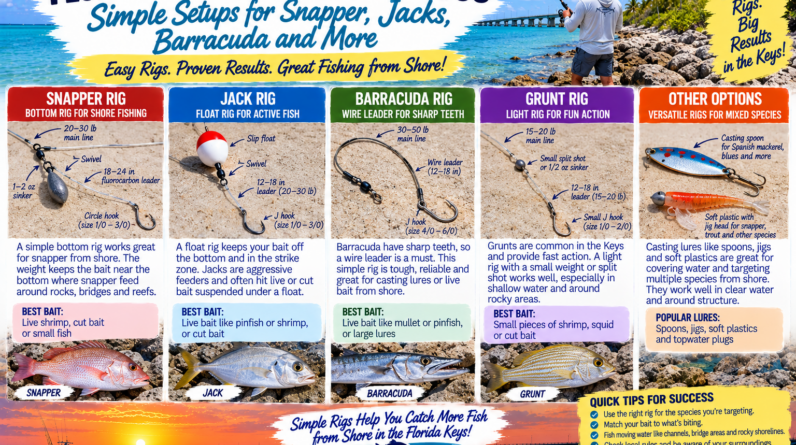
Florida Keys Shore Fishing Rigs for Mangrove Snapper
Mangrove snapper are one of the fish shore anglers often target around Keys structure.
They like:
- Bridges
- Pilings
- Mangroves
- Rocks
- Docks
- Channels
Simple rigs include:
- Free-lined shrimp
- Knocker rig
- Jig and shrimp
- Small live bait rig
The difficult part is not always getting the bite.
It is stopping the fish from getting back into the structure.
Use enough leader strength to give yourself a chance.
If you hook a good snapper beside a piling, do not give it ten feet of free line.
Keep Snapper Rigs Simple
Snapper can be leader-shy in clear water.
You may need to balance abrasion resistance against visibility.
If you are getting no bites, consider:
- Smaller hook
- Lighter leader
- Less weight
- Smaller bait
- More natural presentation
If every fish breaks you off, move the other direction.
Use stronger tackle.
Fishing is full of these little compromises.
Florida Keys Shore Fishing Rigs for Jacks
Jacks are not subtle.
If they are feeding, you may not need much finesse.
Artificial lures work especially well.
Try:
- Spoon
- Jig
- Paddle-tail soft plastic
- Small swimming plug
Cast beyond the fish.
Retrieve through them.
Jacks pull much harder than their size suggests.
They are an excellent fish for someone who simply wants action.
Barracuda Need a Different Approach
Barracuda have teeth.
That changes things.
A normal light fluorocarbon leader may disappear the moment a barracuda closes its mouth.
If you are intentionally targeting them, consider a heavier abrasion-resistant or wire leader appropriate for the size of fish you expect.
Artificial lures can work very well.
Possible choices include:
- Long plugs
- Spoons
- Jigs
- Baitfish imitations
Do not put your fingers near a barracuda’s mouth.
Bring pliers.
Can You Catch Barracuda on a Snapper Rig?
Yes.
Usually when you did not want to.
Barracuda often hang around areas where smaller fish are feeding.
You may hook a snapper and suddenly see a barracuda appear behind it.
Sometimes the barracuda takes the fish.
Sometimes it cuts the line.
That is Florida Keys fishing.
Florida Keys Shore Fishing Rigs for Tarpon
Tarpon require more thought.
A small snapper rig is not a serious tarpon setup.
Even moderate tarpon are powerful fish.
If you plan to target them from shore, use:
- Stronger rod
- Larger reel
- Heavier main line
- Strong leader
- Hook appropriate for the bait
- Enough line capacity
Live bait, crabs, shrimp, and artificial lures can all produce depending on location and season.
The specific setup changes with fish size and fishing location.
If you are new to tarpon fishing, talk to a local tackle shop before rigging.
Think About Where the Tarpon Can Run
This matters around bridges.
Hooking the fish is only the beginning.
A tarpon may head directly toward:
- Pilings
- Channel markers
- Boats
- Deep water
- Bridge structure
You need tackle that gives you some control.
You also need a realistic plan for releasing the fish safely.
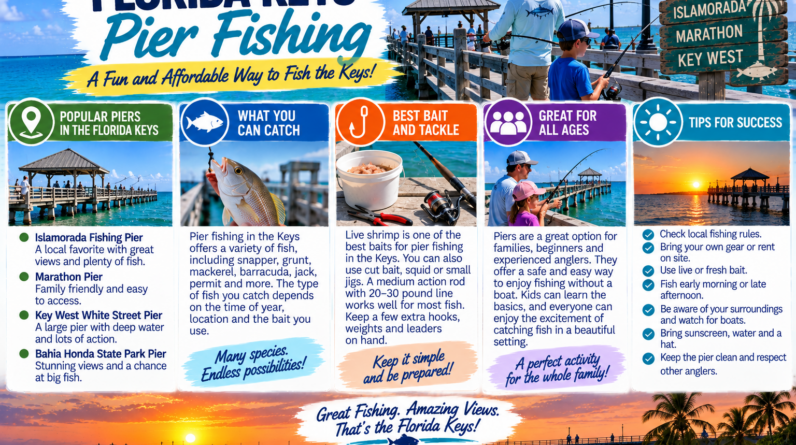
Florida Keys Shore Fishing Rigs for Piers
Pier fishing is usually easier if you keep rigs compact.
Good choices include:
- Knocker rig
- Jig and shrimp
- Live bait rig
- Free-lined bait when current allows
Fish close to the structure first.
Do not assume your best cast is the farthest cast.
Snapper and other fish may be directly below you.
Our Florida Keys Pier Fishing guide covers pier fishing in more detail.
Florida Keys Shore Fishing Rigs for Bridges
Bridge fishing often requires more weight and stronger tackle.
Current and structure are the main problems.
Useful setups include:
- Knocker rigs
- Fish finder rigs
- Jigs
- Live bait rigs
- Artificial lures
Carry several sinker sizes.
The weight you need at 8 a.m. may be completely wrong by 10 a.m.
Our Florida Keys Bridge Fishing guide covers bridge fishing, tides, structure, and landing fish.
Florida Keys Shore Fishing Rigs for Beaches
Beach fishing is often lighter and more mobile.
You may not need much weight at all.
Try:
- Free-lined shrimp
- Small jig
- Soft plastic
- Spoon
- Small plug
Look for:
- Grass edges
- Sand holes
- Small channels
- Baitfish
- Drop-offs
- Moving water
Our Florida Keys Beach Fishing guide covers this style in more detail.
Florida Keys Shore Fishing Rigs for Wading
When wading, less gear is better.
You do not want a giant tackle bag swinging around your waist.
Bring a few:
- Jigs
- Soft plastics
- Spoons
- Small plugs
- Leader spools
- Spare hooks
A simple lure tied directly to a fluorocarbon leader may be all you need.
If you are wading shallow flats, stealth often matters more than elaborate tackle.
Read our Florida Keys Wading Fishing guide before heading onto unfamiliar flats.
What Hooks Should You Carry?
For general shore fishing, carry several sizes rather than one.
Your hook should match:
- Bait size
- Target fish
- Fishing technique
- Current regulations
Smaller shrimp need smaller hooks.
Larger live bait needs more hook.
Large fish require tackle strong enough to handle them.
Do not automatically use the largest hook because you hope to catch a large fish.
A giant hook in a tiny shrimp looks ridiculous to fish too.
Circle Hooks Can Be Useful With Natural Bait
Circle hooks can reduce deep hooking when used properly.
Instead of jerking hard to set the hook, let the line come tight and begin reeling.
They are especially useful for many bait-fishing situations.
Some fisheries also require specific hook types.
Always check the current Florida rules for the fish you intend to target.
Check current FWC saltwater fishing regulations
Carry Several Leader Strengths
Leader may be the most useful thing in your tackle bag.
Florida Keys water can be clear.
Fish can also be surrounded by nasty structure.
Carry more than one option.
For example, you might carry:
- Light leader for clear shallow water
- Medium leader for general fishing
- Heavier leader for bridges and structure
You can adjust without changing your entire rod setup.
Fluorocarbon vs. Monofilament Leader
Both work.
Fluorocarbon is popular because it is abrasion resistant and less visible underwater.
Monofilament is inexpensive, easy to knot, and perfectly useful in many situations.
You do not need to turn this into a religious debate.
Use what works.
Carry both if you want.
Swivels Are Useful, but Not Always Necessary
A swivel can help:
- Connect main line to leader
- Reduce line twist
- Build sliding sinker rigs
But every extra piece of hardware adds another knot and another thing in the water.
If you are free-lining a shrimp in shallow clear water, you may not need one.
If you are building a fish finder rig, it makes sense.
Use hardware because it serves a purpose.
Learn Three Knots Before Your Trip
You do not need to memorize twenty fishing knots.
Know how to:
- Tie leader to main line
- Tie a hook or lure
- Tie a loop if your fishing style requires it
Practice before you go.
Trying to learn a new knot on a dark bridge with wind blowing while everyone else catches fish is not much fun.
What Sinkers Should You Carry?
A small assortment is enough.
Consider:
- Split shot
- Small egg sinkers
- Medium egg sinkers
- Heavier weights if fishing strong current
You do not need every sinker in the tackle store.
Carry enough range to deal with changes in current and water depth.
Live Shrimp Is a Great Starting Bait
If you have no idea what to buy, start with shrimp.
It can catch many common Keys species.
Shrimp is also easy to rig.
You can:
- Free-line it
- Put it on a jig
- Fish it on a knocker rig
- Fish it under a small float in appropriate water
That versatility makes it useful for tourists who do not want to carry a lot of bait.
What About Frozen Shrimp?
It can catch fish.
Fresh or live bait may perform better in many situations, but frozen shrimp is:
- Cheap
- Easy to store
- Easy to transport
- Widely available
If your goal is simply to get a line in the water for an hour with the kids, it can work.
Cut Bait Can Catch Bigger Fish
Cut bait creates scent.
That can attract:
- Snapper
- Jacks
- Sharks
- Other predators and scavengers
Use pieces appropriate for your target.
Do not put out giant chunks of bait unless you have the tackle and knowledge to handle whatever may eat them.
Keep Bait Fresh
Warm dead bait gets nasty quickly in Florida.
Keep bait:
- Cool
- Shaded
- On ice when appropriate
If you buy live shrimp, ask the bait shop how to keep them alive for the amount of time you plan to fish.
Do You Need a Float?
Sometimes.
A float can keep bait:
- Above grass
- Away from snags
- At a selected depth
- Visible to you
It can work well around shallower shorelines and mangrove edges.
Around heavy current or deep bridge channels, bottom rigs may make more sense.
Do Not Over-Rig Clear Water
The Florida Keys can have very clear water.
Heavy swivels, giant clips, huge hooks, and unnecessary hardware can work against you.
If the fishing is slow, simplify.
Sometimes reducing the amount of stuff between you and the bait is the best change you can make.
But Do Not Fish Too Light Around Structure
There is another side to that.
A beautiful light setup does not help if every fish breaks you off against a bridge piling.
Match the tackle to the environment.
Open flat?
You can often fish lighter.
Concrete bridge?
Give yourself more strength.
What Should Be in a Small Florida Keys Shore Fishing Tackle Box?
You can cover a lot of fishing with:
- Hooks in several sizes
- Jig heads
- Egg sinkers
- Split shot
- Small swivels
- Fluorocarbon leader
- Mono leader
- Soft plastics
- Spoons
- Small plugs
- Pliers
- Line cutter
That fits in a small bag.
Add bait and one rod.
Go fishing.
Do Not Forget a Dehooker or Pliers
This is one piece of gear worth carrying every time.
You may catch fish with:
- Teeth
- Spines
- Sharp gill plates
- Strong jaws
Pliers let you remove hooks without putting your fingers near the dangerous end of the fish.
They also help with stubborn hooks and cutting leader.
Match the Rig to the Spot, Not Just the Fish
This is one of the easiest mistakes to make.
You decide you want snapper.
You search for the perfect snapper rig.
But the ideal rig changes depending on whether you are fishing:
- A shallow mangrove shoreline
- A deep bridge channel
- A pier
- A sandy beach
- A grass flat
Location affects weight, leader, casting distance, and tackle strength.
Start with the water in front of you.
Then choose the rig.
Ask the Bait Shop for One Rig
You do not need to walk into a tackle shop and ask them to teach you the entire Florida Keys fishery.
Say:
“I’m fishing from this bridge tomorrow morning. What one rig would you use?”
That is specific.
They can tell you:
- Hook size
- Leader
- Sinkers
- Bait
- Tide considerations
Then buy what they recommend.
Our Florida Keys Bait Shops guide can help you find a nearby shop.
Florida Keys Shore Fishing Rigs Should Stay Simple
You can spend hours debating tackle online.
Or you can tie on a shrimp and go fishing.
Start simple.
Carry enough terminal tackle to make adjustments.
Use heavier gear around nasty structure.
Use lighter presentations in clear open water.
Pay attention to current.
And change the rig when the water tells you to.
That is more useful than memorizing dozens of complicated setups.
Keep Planning Your Land-Based Fishing Trip
Start with our Florida Keys Fishing Without a Boat guide.
If you still need a place to fish, use our Florida Keys Fishing Spots From Shore guide.
You can also read: