

Table of Contents
Florida Keys Beach Fishing: How to Fish From the Sand Without a Boat
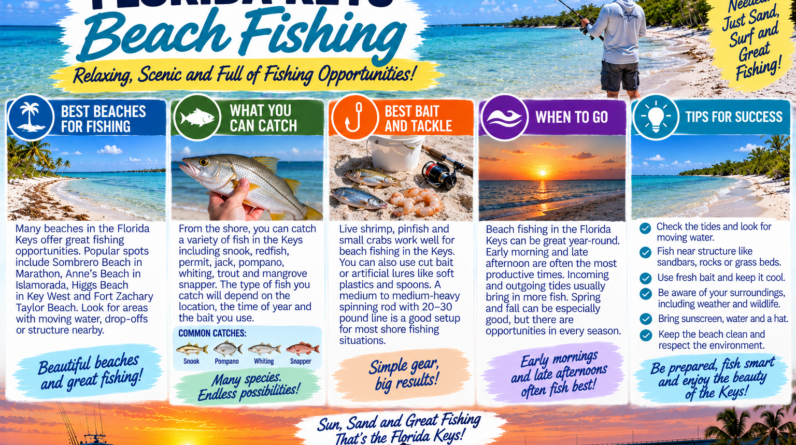
Florida Keys beach fishing can be a simple way to get a line in the water without booking a charter, launching a kayak, or standing on a bridge.
You grab a rod.
Walk to the water.
Cast.
That is the easy part.
The harder part is knowing which beaches allow fishing, what species may be within reach, how tides affect the bite, and how to fish without creating problems for swimmers or wildlife.
Beach fishing in the Keys is not exactly the same as traditional surf fishing farther north in Florida.
Many Keys beaches are smaller.
Some are protected swimming areas.
Some have shallow flats instead of pounding surf.
And public access can be limited.
If you pick the right location and fish at the right time, it can still be a fun part of a Florida Keys trip.
Is Florida Keys Beach Fishing Any Good?
Yes, but expectations matter.
You are not usually standing on a huge Atlantic surf beach casting into crashing waves.
Much of the Florida Keys shoreline is protected by reefs, shallow flats, mangroves, and nearshore structure.
That changes the fishing.
Depending on the location and season, beach anglers may encounter:
- Jacks
- Barracuda
- Snapper
- Snook
- Tarpon
- Sharks
- Pinfish
- Needlefish
- Other inshore species
You may also see rays, baitfish, turtles, and other marine life moving through shallow water.
Some days the beach looks empty.
Other days bait shows up and everything changes quickly.
Florida Keys Beach Fishing Is Different From Surf Fishing
If you have surf fished the Atlantic coast, you may be used to long rods, heavy sinkers, sand spikes, and breaking waves.
You may not need all of that in the Keys.
A lot of beach fishing here is closer to shallow-water inshore fishing.
You may be casting across:
- Sand flats
- Grass edges
- Small channels
- Drop-offs
- Rocky bottom
- Mangrove edges
- Clear shallow water
A seven-foot spinning rod may make more sense than a twelve-foot surf rod.
It depends entirely on the beach.
Where Can You Go Beach Fishing in the Florida Keys?
Start with legal public access.
Do not assume that every beach allows fishing.
Some beaches have designated swimming areas where casting hooks around swimmers would obviously be a bad idea.
Others may have park-specific rules.
Look for:
- State parks
- County beaches
- Public waterfront parks
- Areas outside designated swimming zones
- Beaches that specifically allow fishing
Always check posted signs before setting up.
The fact that a beach is public does not automatically mean fishing is allowed everywhere on it.
State Parks Can Be Good Places to Check
Several Florida Keys state parks provide saltwater access, but rules differ by park and location.
For example, Bahia Honda State Park allows fishing in designated areas subject to Florida fishing regulations. Some activities, including spearfishing and collection of tropical fish, are prohibited inside park boundaries. Florida Keys & Key West
Other parks may offer shoreline or flats access rather than a traditional beach-casting setup.
Check the park’s current rules before you go.
Do You Need a License for Florida Keys Beach Fishing?
Usually, yes.
Florida requires a saltwater fishing license when you take or attempt to take saltwater fish unless an exemption applies.
That includes catch-and-release fishing. MyFWC
For non-residents age 16 and older, FWC currently lists:
- 3-day saltwater license: $17
- 7-day saltwater license: $30
- Annual saltwater license: $47
Florida residents who only fish from shore can qualify for the state’s no-cost shoreline saltwater fishing license. MyFWC
If you are visiting from another state, do not assume shore fishing is free just because you are not on a boat.
What If You Wade Out From the Beach?
That can still count as shore fishing.
FWC says anglers using the Florida resident shoreline license remain covered while wading as long as they can stand on the bottom and did not reach the fishing area by boat. MyFWC
For visiting anglers, the normal non-resident saltwater license requirement still applies unless another exemption covers you.
Our Florida Keys Wading Fishing guide covers wading in more detail.
What Is the Best Bait for Florida Keys Beach Fishing?
Live shrimp is a good starting point.
It is easy to find and can catch a lot of different species.
Other options include:
- Pilchards
- Pinfish
- Cut bait
- Squid
- Small live baitfish
The best bait depends on what is around.
If jacks and barracuda are chasing bait, artificial lures may work better.
If you are trying to catch snapper around rocks or grass, shrimp may be easier.
A local bait shop can usually tell you what has been working recently.
Our Florida Keys Bait Shops guide is a good place to start.
Artificial Lures Work Well From the Beach
One of the best things about beach fishing is mobility.
You can walk.
Cast.
Move.
Cast again.
That makes artificial lures a natural fit.
Try carrying a few:
- Small jigs
- Soft plastics
- Paddle tails
- Spoons
- Small plugs
- Topwater lures
You do not need a huge tackle box.
A small bag with a handful of lures can be enough for a morning.
Look for More Than Just Open Water
Do not stand in one place and blindly cast straight ahead.
Look for differences in the water.
That may include:
- Darker grass patches
- Lighter sand holes
- Channel edges
- Drop-offs
- Rocks
- Points
- Mangrove edges
- Schools of bait
- Birds feeding
- Fish pushing wakes
Those changes can concentrate fish.
A cast to the edge of a grass flat may be much better than a cast into featureless sand.
Polarized Sunglasses Help a Lot
The Keys often have clear water.
That is good for fishing if you can see into it.
Polarized sunglasses help cut glare and make it easier to spot:
- Fish
- Stingrays
- Grass
- Sand
- Drop-offs
- Bait
- Rocks
- Deeper channels
Sometimes you can actually see fish before casting.
That makes beach fishing much more interesting.
Tide Matters
A beach can look completely different as the tide changes.
During lower water, fish may pull away from shallow areas.
As the tide rises, they may move closer to shore.
Outgoing water can concentrate fish around channels or cuts.
Do not assume a beach is bad because you fished it once for thirty minutes.
You may simply have been there during the wrong stage of the tide.
Moving Water Is Usually Worth Watching
Current is not as obvious on every beach as it is around a bridge.
But water still moves.
Look at:
- Points
- Cuts
- Channels
- Creek mouths
- Mangrove openings
If bait is being pushed through a narrow area, predators may wait nearby.
Early Morning Can Be a Great Time to Fish
Early morning has a few advantages.
It is cooler.
Beaches are often less crowded.
There may be fewer swimmers.
And fish may move into shallower water during lower-light periods.
That does not mean sunrise always beats the tide.
If the best water movement happens later, tide may matter more.
But fishing early can make the experience much easier.
Evening Can Be Good Too
Late afternoon and evening can also be productive.
The heat starts to drop.
Beach traffic may thin out.
And fish may move closer to shore as light fades.
Check the park or beach closing time before planning an evening session.
Some public areas close at sunset.
Fishing Around Swimmers Is a Bad Idea
This should be obvious.
Unfortunately, it is not always treated that way.
Hooks and swimmers do not mix.
If people are swimming in front of you, move.
Do not cast between them.
Do not soak bait in a crowded swimming zone.
Do not assume everybody else should stay out of your fishing area because you arrived first.
Find a quieter stretch.
Beach Fishing With Kids Can Work Well
A beach can be a good place to introduce children to fishing.
They are not stuck on a boat.
They can take breaks.
They can walk around.
And if fishing gets boring, the day is not ruined.
Keep the setup easy.
A small hook and shrimp can be much more entertaining than trying to target one giant fish all morning.
Bring:
- Water
- Snacks
- Sunscreen
- Hat
- Simple tackle
- Extra patience
Watch for Stingrays While Wading
Shallow Florida waters can hold stingrays.
If you walk into the water, shuffle your feet rather than taking large steps.
That gives a resting ray a better chance to move before you step directly on it.
This is another reason polarized glasses help.
Do Not Wade Into Water You Cannot Read
Clear shallow water can be deceptive.
The bottom may suddenly change from:
- Firm sand
- To soft mud
- To grass
- To a deeper channel
Walk slowly.
Do not charge straight out because the water looks shallow.
If the bottom starts getting soft or the current increases, turn around.
What Rod Should You Use?
For general Florida Keys beach fishing, a medium spinning rod is a good starting point.
Something around seven feet works well for many situations.
A basic setup might include:
- Medium spinning rod
- Saltwater spinning reel
- Braided main line
- Fluorocarbon or mono leader
- Small hooks
- A few sinkers
- Several lures
You do not need heavy surf gear unless the specific conditions call for it.
Do You Need a Sand Spike?
Maybe.
If you plan to fish bait and leave the rod sitting, a sand spike can be useful.
If you are walking and casting lures, it may just be extra stuff to carry.
Think about how you plan to fish before loading up the car.
Bring Less Than You Think
A beach trip is much easier when you stay mobile.
You may only need:
- One rod
- Small tackle bag
- Pliers
- Bait
- Water
- Sunscreen
- Polarized glasses
- Small cooler if keeping legal fish
You do not need six rods, three chairs, and a wagon for a two-hour fishing session.
Can You Keep Fish You Catch From the Beach?
Yes, if the fish is legal to harvest.
The same state regulations apply.
You still need to follow:
- Size limits
- Bag limits
- Seasons
- Protected species rules
- Gear restrictions
Check the current FWC regulations before keeping anything.
Florida saltwater fishing regulations
Be Extra Careful With Snook
Snook can sometimes be caught around Florida beaches and passes.
If you plan to keep one when harvest is open, Florida requires the appropriate snook permit in addition to the required fishing license. MyFWC
Snook regulations are regional and seasonal.
Check current rules before fishing specifically for harvest.
Florida Keys Beach Shark Fishing Has Extra Rules
If you plan to target sharks from the beach, the rules change.
Florida requires shore-based shark anglers age 16 and older to complete an educational course and obtain the no-cost shore-based shark fishing permit. MyFWC
Special hook and release rules also apply.
FWC requires non-offset, non-stainless-steel circle hooks when targeting sharks with natural bait. Anglers must also have a device capable of quickly cutting the leader or hook. MyFWC
Many shark species are protected and must be released.
Do not attempt serious beach shark fishing without reading the current rules first.
Chumming From the Beach Is Prohibited
This one is easy to miss.
FWC says chumming is prohibited when fishing for any species from the beach or while wade fishing in waters next to a beach. MyFWC
That means you should not throw fish pieces, ground bait, or other chum into the water to attract fish while beach fishing.
This restriction applies even if sharks are not your target.
Shark Fishing Near Swimmers Is a Terrible Plan
FWC specifically advises shore-based shark anglers to avoid crowded beaches and high-traffic swimming areas. MyFWC
That should be common sense.
If families are swimming nearby, do not deploy large shark baits.
Find another location.
Sea Turtles Matter at Night
Florida beaches can be important nesting habitat.
FWC notes that sea turtle nesting season runs from March through October and recommends amber or red lighting when fishing from shore during that period. MyFWC
Avoid bright lights pointed toward the beach.
Do not interfere with nests or turtles.
If a beach has lighting rules, follow them.
Beach Fishing at Night Can Be Fun
Night fishing can be productive.
The beaches are quieter.
Temperatures are lower.
Some fish move shallow after dark.
But night fishing also makes everything harder.
You need to think about:
- Lighting
- Beach hours
- Parking
- Tides
- Wildlife
- Hooks
- Navigation back to the car
Do not choose an unfamiliar remote beach for your first solo night fishing trip.
Keep Your Light Under Control
A headlamp is useful.
A giant spotlight usually is not.
Use only as much light as you need.
This is especially important during turtle nesting season.
Red or amber lighting is a better choice where required or recommended.
Leave the Beach Cleaner Than You Found It
Fishing line is dangerous around wildlife.
Pick up:
- Monofilament
- Braided line
- Hooks
- Bait packaging
- Plastic bags
- Food trash
Do not bury cut line in the sand.
A bird or turtle can find it later.
Beach Fishing vs. Bridge Fishing
Bridge fishing gives you more structure and often deeper water.
Beach fishing gives you more room to move.
A bridge may be better if you want:
- Snapper around pilings
- Deeper channels
- Strong current
- Larger structure
A beach may be better if you want:
- Shallow-water fishing
- Walking and casting
- More open space
- A relaxed trip with kids
Read our Florida Keys Bridge Fishing guide if structure fishing sounds more appealing.
Beach Fishing vs. Wading
The two often overlap.
You might start on the sand and end up knee-deep on a flat.
Wading gives you extra casting range and lets you reach fish farther from shore.
It also adds more safety concerns.
If you plan to spend much time in the water, read our Florida Keys Wading Fishing guide first.
Ask a Bait Shop About Beach Access
This can save a lot of driving.
Walk into a shop and ask:
“Is there a beach nearby where fishing is allowed?”
Then ask:
“What would you throw there today?”
That is much more useful than asking where the best fishing spot in the entire Florida Keys is.
Conditions change.
Local information helps.
Florida Keys Beach Fishing Is Best Kept Simple
You do not need an elaborate plan.
Find a legal beach.
Check the tide.
Bring one rod.
Carry a few lures or some shrimp.
Look for bait and structure.
Stay away from swimmers.
And move if nothing is happening.
That is enough for a good morning.
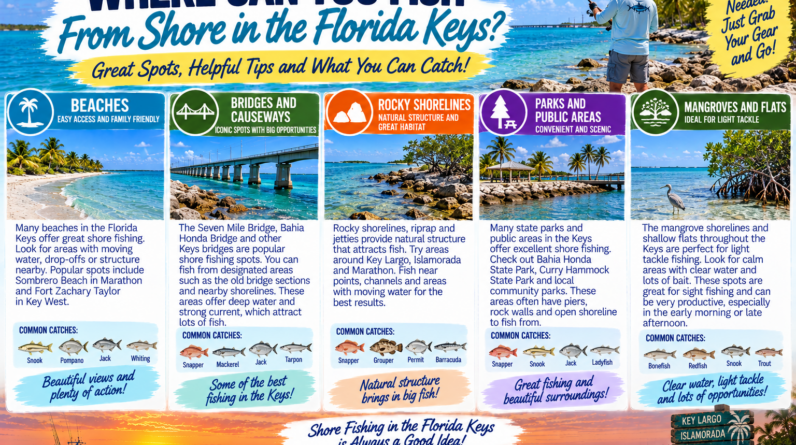
More Ways to Fish the Florida Keys Without a Boat
Beach fishing is one part of the larger land-based fishing picture.
Start with our Florida Keys Fishing Without a Boat guide.
Then read:
Florida Keys Fishing Spots From Shore