

Table of Contents
Florida Keys RV Fishing Packing List: What to Bring
A Florida Keys RV fishing trip is easier when your gear is organized before you pull out of the driveway. This Florida Keys RV Fishing Packing List will help!
You need normal RV supplies.
You need fishing gear.
You may need boat or kayak equipment.
And you need a plan for bait, fish, saltwater, heat, rain, and wet equipment.
That can turn into a surprisingly long list.
The good news is that you do not need to bring your entire garage.
A smart Florida Keys RV fishing packing list focuses on the items that are difficult, expensive, or annoying to replace after you arrive.
Everything else can usually be picked up at a local bait shop, grocery store, marina, or hardware store.
Here is what to bring.
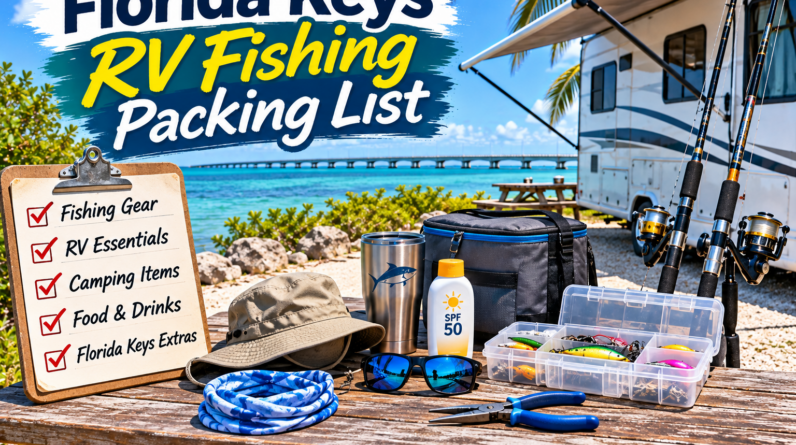
Florida Keys RV Fishing Packing List
If you want the quick version, start with:
- Fishing rods and reels
- Fishing license
- Tackle
- Leader material
- Pliers and cutters
- Polarized sunglasses
- Hat
- Sunscreen
- Lightweight fishing clothing
- Rain gear
- Fishing cooler
- Bait cooler
- Ice
- Waterproof storage bins
- Fishing towels
- Fish-cleaning knife
- First-aid kit
- Drinking water
- Bug spray
- Headlamp
- Portable light
- RV power adapters
- Water hose
- Sewer equipment
- Wheel chocks
- Leveling blocks
- Surge protector
- Extension cord if appropriate
- Outdoor mat
- Folding chairs
- Boat or kayak equipment if bringing one
- Copies of campground, marina, and charter reservations
That is the short version.
Now let us look at what actually deserves space in the RV.
Start With Your Fishing License
Do not wait until you are standing beside a fishing bridge to figure this out.
Florida generally requires non-residents age 16 and older to have a recreational saltwater fishing license when fishing independently unless an exemption applies.
Fishing catch and release still counts as fishing.
Current non-resident saltwater options include:
- 3-day license
- 7-day license
- Annual license
Passengers fishing aboard a properly licensed charter or party boat generally do not need their own recreational saltwater fishing license for that trip.
Check current requirements before leaving:
https://myfwc.com/license/recreational/visitors/
Download Your License Before the Trip
Do not depend completely on campground Wi-Fi or cell service.
Keep your license accessible through the Fish|Hunt Florida app or save the necessary information on your phone.
If you prefer paper, print a copy.
You probably will not need it.
That is exactly why having it is easy.
Check for Extra Fishing Permits
A regular saltwater license does not cover every situation.
Depending on what you plan to target, Florida may require additional permits or registrations.
Examples can include:
- Shore-based shark fishing permit
- State Reef Fish Angler designation
- Snook permit
- Spiny lobster permit
- Tarpon tag under specific circumstances
Check the current permit list:
https://myfwc.com/license/recreational/saltwater-fishing/
Do this before deciding what fishing gear to pack.
How Many Fishing Rods Should You Bring?
You probably do not need ten.
For a general RV fishing trip, two or three setups can cover a lot.
A practical collection might include:
Medium Spinning Setup
Useful for:
- Snapper
- Jacks
- Small mackerel
- General shore fishing
- Light bridge fishing
Medium-Heavy Spinning Setup
Useful for:
- Larger snapper
- Barracuda
- Strong current
- Bridge fishing
- Bigger inshore fish
Specialized Setup
Bring one only if you know you need it.
That might be:
- Fly rod
- Heavy tarpon setup
- Shark setup
- Offshore trolling rod
- Kayak-specific rod
Match the third rod to the trip.
Bring Saltwater-Ready Reels
Saltwater is hard on fishing equipment.
If you are bringing freshwater reels, rinse them carefully after use and understand that salt can quickly cause corrosion.
A saltwater-capable spinning reel is a better choice for repeated Keys fishing.
You do not need the most expensive reel available.
You do want one with:
- Smooth drag
- Adequate line capacity
- Corrosion resistance
- Reliable handle
- Strong bail system
Bring Extra Fishing Line
Lines get damaged.
Bridges have pilings.
Reefs have structure.
Barracuda have teeth.
Snags happen.
Bring extra:
- Braided line
- Monofilament
- Fluorocarbon leader
You do not necessarily need full replacement spools of every line.
At minimum, bring enough leader material to rebuild rigs throughout the trip.
Leader Material Belongs Near the Top of the List
Clear Keys water can make leader selection matter.
Different fishing may call for different strengths.
You might carry several leader sizes rather than one giant spool of heavy mono.
That gives you options for:
- Snapper
- Mackerel
- Barracuda
- Tarpon
- General bridge fishing
Ask a local tackle shop what has been working recently before tying everything at home.
Hooks
Bring several sizes.
Circle hooks are useful for many saltwater applications.
J-hooks may have other uses.
Specific fisheries can have hook requirements, so check current regulations for what you plan to target.
Store hooks in a sealed tackle box.
Saltwater humidity can rust an open package surprisingly quickly.
Sinkers
Current can be strong around bridges and channels.
Bring a selection of:
- Egg sinkers
- Bank sinkers
- Split shot
- Other weights appropriate to your rigs
Do not bring 20 pounds of lead unless you know you need it.
You can buy more in the Keys.
Jigs
Jigs are simple and useful.
Bring a few different:
- Weights
- Colors
- Head styles
They can work for:
- Snapper
- Jacks
- Mackerel
- Other inshore fish
Soft plastics can be paired with them for an easy artificial setup.
Artificial Lures
A compact lure box is enough for most RV anglers.
Possible choices include:
- Spoons
- Jigs
- Soft plastics
- Topwater plugs
- Small diving plugs
- Shrimp imitations
Do not fill half the RV with tackle you have not used in five years.
Bring what you know how to fish.
Pliers
Bring at least one good pair of saltwater pliers.
Two is better.
You will use them for:
- Removing hooks
- Cutting leader
- Crimping
- Handling rigs
- Straightening hardware
Keep one pair in your main tackle box and another in the RV.
Line Cutters
Do not rely entirely on the cutting edge built into old pliers.
Bring:
- Braid scissors
- Line cutters
- Small utility scissors
Braid can be frustrating to cut with dull tools.
Hook Remover
A long hook-removal tool can help with toothy or deeply hooked fish.
It can also reduce how much you need to handle the fish.
That is useful around:
- Barracuda
- Mackerel
- Sharks
- Larger snapper
Landing Net
A landing net can be useful when fishing from:
- Shore
- Low docks
- Kayaks
- Small boats
Bridge fishing is different.
If you are fishing from an elevated bridge, a traditional landing net may not reach the water.
Some bridge anglers use specialized bridge nets.
Do not assume your normal boat net will work.
Fish Gripper
A fish gripper can help control certain fish.
Use it appropriately.
Do not suspend a large fish vertically for long periods simply for a photograph.
For fish you plan to release, quick handling is better.
Measuring Device
Bring a fish ruler or measuring board.
Fishing regulations can specify:
- Total length
- Fork length
- Lower jaw fork length
depending on the species.
Know which measurement applies before keeping fish.
A small tape measure thrown into the tackle bag is better than guessing.
Current Fishing Regulations
Save the FWC saltwater regulations page to your phone:
https://myfwc.com/fishing/saltwater/recreational/
Rules can include:
- Size limits
- Bag limits
- Closed seasons
- Gear restrictions
- Special zones
Do not rely on an old screenshot from a fishing forum.
Fish Identification
The Keys have many similar-looking reef fish.
If you plan to keep fish, identification matters.
Consider keeping a fish-identification resource on your phone.
If you cannot confidently identify a fish and confirm it is legal, release it.
That is much easier than trying to solve the problem after the fish is in the cooler.
Polarized Sunglasses
Do not forget these.
Polarized lenses reduce glare and help you see into the water.
That can help when:
- Flats fishing
- Looking for fish near mangroves
- Watching bait
- Wading
- Kayak fishing
- Checking shallow water around a boat
Bring a strap.
The ocean does not return sunglasses.
Fishing Hat
Bring a hat that stays on your head.
A baseball cap works.
A wide-brimmed hat provides more sun coverage.
If you are running a boat, make sure it will not disappear the first time you get on plane.
Sunscreen
The Keys sun is strong.
Water reflects additional sunlight.
Bring enough sunscreen to reapply.
Do not forget:
- Ears
- Neck
- Nose
- Hands
- Tops of feet
Keep one bottle in the RV and another in the fishing bag.
Long-Sleeve Fishing Shirts
Lightweight long sleeves are extremely useful.
They provide sun protection without requiring constant sunscreen on your arms.
Pack several if you plan to fish most days.
Saltwater shirts get dirty fast.
Lightweight Fishing Pants
Shorts work.
Lightweight fishing pants can give you additional sun and bug protection.
They are especially useful when:
- Kayaking
- Wading
- Fishing around mangroves
- Spending long days outside
Rain Gear
Florida weather can change quickly.
Bring a lightweight waterproof jacket.
If you have room, add waterproof pants.
Rain gear also works as an extra wind layer during cooler winter mornings.
Light Jacket
Do not assume Florida means you will never feel cold.
Winter mornings can feel chilly.
Add boat speed, ocean spray, and wind and it can feel much cooler.
Pack a light jacket or fleece if traveling during the cooler months.
Fishing Shoes
Choose footwear that can handle:
- Water
- Salt
- Slippery ramps
- Boat decks
- Mud
- Rocks
If you are fishing from a charter, ask the captain whether they have footwear preferences.
Some boats discourage dark marking soles.
Wading Shoes
If you plan to wade flats or shallow shorelines, proper footwear can protect you from:
- Sharp rocks
- Shells
- Coral debris
- Uneven bottom
Do not casually wade unfamiliar water barefoot.
Fishing Gloves
Fishing gloves can help with:
- Leader handling
- Sun protection
- Rough fish
- Line
They are optional for general fishing but useful if you plan to fish frequently.
Fishing Cooler
Bring a dedicated fishing cooler.
Use it for:
- Legal fish
- Ice
- Bait
Do not make your main food cooler double as the fish cooler unless you want everything in it to smell like bait.
A separate cooler is worth the space.
Bait Cooler
A small inexpensive cooler works well for bait.
You may be carrying:
- Shrimp
- Squid
- Cut bait
- Frozen baitfish
Keeping this separate from food makes RV life much nicer.
Bring Ice Money
You do not need to tow hundreds of pounds of ice from home.
You do need to budget for buying it repeatedly.
Ice disappears quickly in Florida heat.
You may use it for:
- Bait
- Fish
- Drinks
- Food
Plan on regular ice stops.
Fish-Cleaning Knife
Bring a sharp fillet knife if you plan to clean your own legal catch.
Also bring:
- Knife sharpener
- Cutting glove if desired
- Heavy-duty bags
Before using the knife, find out where fish cleaning is allowed.
Some campgrounds require you to use a designated station.
Do Not Clean Fish Beside the RV Without Asking
This is one of the fastest ways to make campground neighbors unhappy.
Fish scraps smell.
They attract wildlife.
They create cleanup problems.
Use:
- Campground cleaning station
- Marina cleaning station
- Charter cleaning facility
when available.
Heavy-Duty Freezer Bags
Bring several sizes.
They work for:
- Fish fillets
- Bait
- Ice
- Wet tackle
- Small gear
- Emergency storage
They take almost no room.
Vacuum Sealer
If you plan to catch and keep fish over several days, a small vacuum sealer can be useful.
You can package cleaned fillets and freeze them.
Check your RV freezer capacity first.
Catching 20 pounds of legal fish is not helpful if your freezer holds two frozen pizzas.
Freezer Space
Think about this before departure.
If keeping fish matters to you, decide:
- How much freezer space is available?
- Will you use campground freezers?
- Is there a local fish processor?
- Will you eat fish during the trip?
- Are you bringing fish home?
Do not discover the freezer problem after you have cleaned dinner for the next three weeks.
Waterproof Storage Bins
These may be some of the most useful things in the RV.
Use separate bins for:
- Fishing tackle
- Wet clothing
- Boat equipment
- Kayak equipment
- Bait gear
Plastic bins keep saltwater and fish slime away from the RV interior.
Fishing Towels
Bring old towels.
Not the nice RV towels.
Use fishing towels for:
- Hands
- Wet tackle
- Fish slime
- Bait
- Cleaning
Store them outside or in a dedicated container after use.
Bucket
A five-gallon bucket has endless uses.
You can use it for:
- Bait
- Gear
- Water
- Cleaning
- Trash
- Carrying fish
Bring a lid.
A lid turns the bucket into storage.
Headlamp
A headlamp is extremely useful for:
- Early-morning departures
- Night fishing
- Rigging
- Walking around the campsite
- Boat setup
Bring spare batteries or a charging cable.
Small Flashlight
Keep another flashlight in the tackle bag.
Redundancy is useful when the headlamp gets left on the picnic table.
Bug Spray
Mosquitoes and biting insects can be a problem in some areas.
Mangroves and calm evenings can be particularly buggy.
Bring repellent.
Do not assume ocean breeze will solve every insect problem.
First-Aid Kit
Keep a well-stocked kit in the RV.
Include supplies for:
- Cuts
- Hooks
- Scrapes
- Burns
- Blisters
Fishing adds sharp hooks, knives, fish teeth, and slippery surfaces to an RV trip.
A basic first-aid kit is easy insurance.
Drinking Water
Do not underestimate how much water you will drink while fishing.
Heat, sun, and salt air can dry you out quickly.
Carry water on every trip.
Keep extra drinking water in the RV.
Reusable Water Bottles
Insulated bottles are useful because warm water gets old fast.
Fill them before leaving the campground.
Snacks
Keep easy fishing food available.
Examples include:
- Granola bars
- Nuts
- Crackers
- Sandwiches
- Fruit
- Jerky
Choose items that can handle heat.
Seasickness Supplies
If you are booking an offshore charter and anyone in the group gets seasick, plan ahead.
Talk with a doctor or pharmacist about appropriate options if necessary.
Do not wait until the boat is already rocking offshore.
Waterproof Phone Case
Saltwater and phones are not friends.
Bring:
- Waterproof case
- Dry bag
- Waterproof pouch
especially for kayaking or wading.
Portable Battery Bank
Fishing days can be long.
Phones get used for:
- Maps
- Weather
- Photos
- Regulations
- Navigation
- Communication
A charged battery bank can be useful.
Marine Weather Access
Save reliable weather sources before the trip.
Use National Weather Service marine forecasts and National Hurricane Center information when relevant.
Atlantic hurricane season runs from June 1 through November 30.
Current tropical information:
https://www.nhc.noaa.gov/
Do not depend only on a generic weather app if you are taking your own boat offshore.
RV Surge Protector
Power quality can vary from campground to campground.
A surge protector can help protect the RV electrical system and electronics.
This has nothing to do with fishing until your air conditioner stops working in July.
Then it becomes very related to fishing.
RV Power Adapters
Bring the appropriate adapters for your rig.
You may encounter:
- 30-amp service
- 50-amp service
- Different campsite configurations
Know what your RV requires.
Freshwater Hose
Bring a drinking-water-safe RV hose.
You may also want a separate hose for non-potable uses where campground rules permit.
Do not mix drinking-water hoses with fish-cleaning or sewer equipment.
Sewer Equipment
Bring:
- Sewer hose
- Fittings
- Gloves
- Support system if you use one
This is basic RV gear, but it is surprisingly easy to forget something when most of your attention is on fishing rods.
Leveling Blocks
Florida may look flat.
Individual campsites are not always perfectly level.
Bring leveling blocks.
Wheel Chocks
Bring proper wheel chocks for your RV or trailer.
Do not improvise with fishing tackle boxes.
Outdoor Mat
An outdoor mat helps keep:
- Sand
- Dirt
- Wet shoes
- Fishing debris
from moving into the RV.
Folding Chairs
You may spend the morning fishing and the evening sitting beside the water.
Bring comfortable chairs.
That is part of the RV trip too.
Outdoor Table
A small folding table can become a useful fishing workstation.
Use it for:
- Rigging
- Tackle organization
- Gear repair
Do not clean fish on it unless campground rules permit.
If You Are Bringing a Boat
Your packing list gets longer.
Consider:
- Registration
- Insurance documents
- Trailer registration
- Spare trailer tire
- Jack
- Lug wrench
- Wheel bearings checked before departure
- Trailer lights
- Tie-down straps
- Dock lines
- Fenders
- Anchor
- Anchor line
- Life jackets
- Throwable flotation device
- Navigation lights
- Fire extinguisher
- Marine radio
- Chartplotter
- Backup navigation
- Bilge equipment
- Tool kit
- Spare fuses
- Spare prop hardware if appropriate
- Engine oil or required fluids
- Flushing equipment where permitted
Do a complete boat safety check before leaving home.
Bring a Spare Trailer Tire
If you tow a boat to the Keys, this deserves its own section.
Bring a proper spare.
Check:
- Tire pressure
- Tire age
- Lug nuts
- Bearings
before departure.
A trailer breakdown on the Overseas Highway is a terrible way to start a fishing vacation.
Boat Documentation
Keep important documents together.
That can include:
- Boat registration
- Trailer registration
- Insurance
- Marina reservation
- Boat-slip confirmation
- Required fishing permits
Store digital copies too.
Dock Lines and Fenders
If you plan to rent a slip, bring enough lines and fenders for your boat.
Do not assume the marina provides them.
Boat Cleaning Supplies
Saltwater equipment needs care.
Bring:
- Corrosion protectant
- Rags
- Basic cleaning supplies
Check campground rules before washing the boat.
Some RV parks prohibit washing boats or vehicles at campsites.
Boat Tool Kit
A small tool kit can save a fishing day.
Include the basic tools that fit your boat.
Possible items include:
- Screwdrivers
- Pliers
- Adjustable wrench
- Socket set
- Electrical tape
- Zip ties
- Spare fuses
You are not trying to rebuild the engine in the campground.
You are trying to handle simple problems.
If You Are Bringing a Kayak
Pack:
- Paddle
- Spare paddle if practical
- PFD
- Whistle
- Dry bag
- Anchor or stake-out system
- Leash where appropriate
- Kayak cart
- Rod holders
- Small tackle box
- Water
- Sun protection
- Navigation or mapping
- Light if fishing around low-light hours
Do not forget the paddle.
People do.
Kayak Roof or Trailer Hardware
Check your:
- Straps
- Rack
- Tie-downs
- Trailer tires
- Lights
before the road trip.
Bring spare straps.
Wading Gear
If wading is part of the plan, consider:
- Proper footwear
- Small tackle bag
- Waterproof phone pouch
- Polarized glasses
- Water
- Pliers
Travel light.
You do not want to carry a giant tackle box across a shallow flat.
Fishing From Bridges
Bridge anglers may want:
- Heavier sinkers
- Stronger leader
- Long-handled tools
- Bridge net where appropriate
- Headlamp for low-light fishing
- Bucket
- Compact chair
Do not block pedestrian paths or traffic.
Check signs before fishing.
Shore Fishing Gear
For basic shore fishing, keep it simple.
A small bag with:
- Hooks
- Sinkers
- Leader
- Jigs
- Pliers
- Bait
- Water
may be enough.
That makes spontaneous fishing much easier.
Pack a Small Grab-and-Go Fishing Bag
This is one of the best RV fishing tricks.
Keep one small bag permanently ready.
Put inside:
- Hooks
- Leader
- Sinkers
- Pliers
- Lures
- Sunscreen
- Headlamp
Then when you spot a legal fishing opportunity, you can grab the rod and bag without unpacking the entire RV.
Keep an RV Fishing Bin Near the Door
A second useful system is a dedicated fishing bin.
Store:
- Shoes
- Gloves
- Fishing towels
- Small tackle bag
- Rain jacket
- Bug spray
in one place.
You will use these items constantly.
Do Not Overpack Food
The Keys have grocery stores, markets, restaurants, bait shops, and convenience stores.
Bring enough food to get started.
You do not need to carry two weeks of groceries unless you prefer to.
Freezer space may be more useful for fish than frozen food.
Bring Cash
Cards are accepted almost everywhere.
Cash is still useful for:
- Tips
- Small bait purchases
- Marina incidentals
- Local fees
Keep a small amount available.
Keep Reservation Information Offline
Save:
- Campground address
- Check-in information
- Site number
- Gate code
- Marina slip
- Charter confirmation
- Captain’s phone number
on your phone before traveling.
A screenshot works.
Do not make your entire trip depend on having a strong signal at check-in.
Check Your RV Height
Know your exact height.
Include:
- Air conditioner
- Antenna
- Roof accessories
You may encounter campground loops or access areas with clearance restrictions.
Bahia Honda State Park is one example where certain campground access is unsuitable for normal RVs because of low clearance.
Check Your RV Length
Know your true length too.
Campground site limits can matter.
Include:
- Hitch
- Rear accessories
- Bike racks where relevant
Do not guess.
Keep Fishing Gear Secure While Driving
Fishing rods are awkward.
Store them where they cannot:
- Fall
- Break
- Damage the RV
- Become projectiles during a hard stop
Rod tubes or secured racks can help.
Saltwater and RV Interiors Are a Bad Combination
Try to keep wet gear outside.
That includes:
- Shoes
- Cast nets
- Kayak gear
- Fishing towels
- Bait buckets
- Wet tackle
Saltwater can damage hardware and make the RV smell.
Plastic bins are your friend.
What You Can Buy After You Arrive
Do not waste RV space carrying everything.
Items that are easy to buy locally include:
- Ice
- Bait
- Hooks
- Sinkers
- Leader
- Basic lures
- Sunscreen
- Drinks
- Snacks
Your local bait shop can also tell you what is working right now.
Use our Florida Keys Bait Shops guide.
What You Should Not Forget
Some things are much more annoying to replace.
Double-check these:
- Prescription medication
- Fishing license
- RV electrical adapters
- Surge protector
- Boat registration
- Boat trailer spare
- PFDs
- Kayak paddle
- Polarized glasses
- Phone charger
- Reservation information
- Necessary specialty fishing tackle
These deserve a final check before departure.
Make a Departure Checklist
The night before leaving, run through the list.
RV
- Power supplies
- Water supplies
- Sewer supplies
- Chocks
- Leveling blocks
- Surge protector
Fishing
- Rods
- Reels
- Tackle
- Leader
- Pliers
- Cooler
- Fishing license
Clothing
- Fishing shirts
- Hat
- Sunglasses
- Rain gear
- Shoes
Boat or Kayak
- Registration
- Safety gear
- Paddle
- PFDs
- Trailer equipment
- Dock lines
Documents
- Campground reservations
- Marina reservations
- Charter information
- Insurance
Five minutes checking the list at home can save hours later.
Do Not Try to Bring Everything
This may be the most useful packing advice.
The Florida Keys are not a remote wilderness expedition.
You can buy fishing gear.
You can buy food.
You can buy ice.
You can replace sunscreen.
Pack the expensive, specialized, and personal items first.
Fill the remaining space with convenience items.
That keeps the RV organized and leaves room for the most important thing you may bring home.
Fish.
Plan Your Florida Keys RV Fishing Trip
Use our Florida Keys RV Fishing guide for the full trip-planning process.
If you are bringing a boat, read Florida Keys RV Parks With Boat Ramps.
If you prefer public campgrounds, use our Florida Keys State Park RV Camping and Fishing Guide.
For the route itself, follow our 7-Day Florida Keys RV Fishing Itinerary.
Then check the Florida Keys Fishing Calendar so you know what species may be available during your dates.
For current Florida fishing licenses and permits, check:
https://myfwc.com/license/recreational/saltwater-fishing/
For current saltwater regulations:
https://myfwc.com/fishing/saltwater/recreational/