

Table of Contents
Kayak Fishing Gear: Essential Equipment and Accessories for Your Kayak
The right kayak fishing gear can make a day on the water safer, more comfortable, and much easier.
You do not need to cover your kayak with every accessory you can find.
In fact, too much gear can create its own problems.
The goal is to carry equipment that helps you:
- Paddle safely
- Keep fishing tackle organized
- Hold your position
- Protect valuables from water
- Land fish
- Stay comfortable
- Keep essential equipment within reach
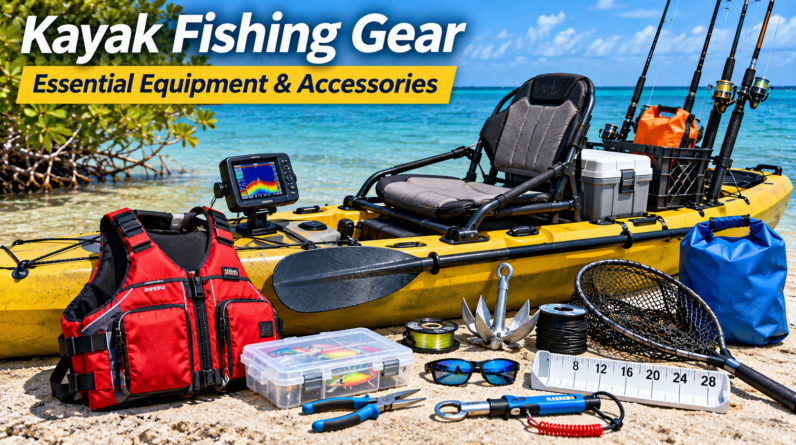
If you are setting up your first fishing kayak or looking for useful upgrades, this kayak fishing gear checklist covers the equipment worth considering.
1. Fishing Kayak
Everything starts with the kayak.
A good fishing kayak should give you enough stability to cast, fight fish, and reach your gear without constantly feeling as though you are about to tip over.
Useful features include:
- Wide stable hull
- Comfortable seat
- Rod holders
- Gear tracks
- Dry storage
- Rear tank well
- Paddle storage
- High enough weight capacity for you and your equipment
Do not choose a kayak based only on how many accessories are attached to it.
The hull, stability, seat, and overall fit matter more.
Sit-On-Top vs. Sit-Inside Fishing Kayak
Most anglers prefer sit-on-top kayaks for fishing.
They provide easier access to gear and are generally easier to get back onto if you fall into the water.
Sit-inside kayaks can work, but they offer less open storage and can be more difficult to use for fishing.
Paddle vs. Pedal Fishing Kayak
A pedal kayak lets you use your legs for propulsion while keeping your hands available for fishing.
That can be helpful for:
- Trolling
- Casting while moving
- Fighting wind
- Holding position
Paddle kayaks are usually:
- Lighter
- Less expensive
- Easier to transport
- Better suited to very shallow water
Both can work well.
Choose based on how and where you plan to fish.
2. Kayak Paddle
Even if you own a pedal kayak, carrying a paddle is smart.
For a traditional paddle kayak, it is one of your most important pieces of equipment.
Look for a paddle that matches:
- Your height
- Kayak width
- Paddling style
A lightweight paddle can make a noticeable difference during a long day.
Heavy paddles become tiring after hundreds or thousands of strokes.
Some fishing paddles include extras such as:
- Hook retrieval slots
- Measuring marks
- Reinforced blades
Those features can be useful, but weight and comfort should come first.
3. Fishing PFD
A personal flotation device should be near the top of your kayak fishing gear list.
Fishing-specific PFDs are designed differently from many basic life jackets.
They often include:
- Higher backs that work with kayak seats
- Front pockets
- Tool attachment points
- Adjustable straps
- Storage for small tackle
Comfort matters.
A PFD that feels bulky or uncomfortable is one you may be tempted not to wear.
Look for one that fits correctly while sitting in your kayak.
4. Paddle Leash
Losing your paddle can turn into a serious problem.
A paddle leash connects the paddle to your kayak.
They are inexpensive, lightweight, and take up almost no room.
That makes one of these a simple addition to almost any fishing kayak.
5. Fishing Rods
You probably do not need five rods on your kayak.
Two can cover most situations.
A common setup might include:
One can handle lighter lures and smaller fish.
The other can handle heavier lures, stronger fish, or heavier cover.
Shorter rod butts can also be easier to manage while sitting.
If you fish saltwater, you can also see our guide to saltwater fishing rods for kayak fishing.
6. Spinning Reel
Spinning reels are practical for kayak fishing because they are easy to cast and versatile.
Look for:
- Smooth drag
- Corrosion resistance
- Comfortable handle
- Adequate line capacity
- Sealed or protected components when fishing saltwater
A reel does not have to be huge.
Match it to your rod and expected fish.
7. Braided Fishing Line
Braided line works well from a kayak because it provides:
- High strength for diameter
- Good casting distance
- Excellent sensitivity
- Low stretch
You can then attach fluorocarbon or monofilament leader based on what you are targeting.
8. Leader Material
Keep leader material somewhere easy to reach.
You may need to change leaders after:
- Catching fish
- Rubbing structure
- Getting cut by teeth
- Changing target species
Useful options include:
- Fluorocarbon
- Monofilament
- Wire leader
You do not need every leader size available.
Carry the sizes that match your fishing.
9. Kayak Rod Holders
Rod holders free up your hands.
That matters when you need to:
- Paddle
- Change lures
- Land a fish
- Eat
- Take a photo
- Handle another rod
Some kayaks include flush-mounted rod holders.
You can also add adjustable holders to gear tracks.
Adjustable models let you change the rod angle for:
- Trolling
- Storage
- Fishing
10. Kayak Crate
A milk crate or purpose-built kayak fishing crate can organize much of your gear in one place.
It can hold:
- Tackle boxes
- Extra rods
- Pliers
- Leader
- Tools
- Water bottle
Purpose-built fishing crates may include rod holders and attachment points.
A basic crate can work just as well for anglers who prefer a simpler setup.
Secure the crate to the kayak.
11. Waterproof Tackle Boxes
Small waterproof tackle boxes work better on a kayak than carrying one giant tackle box.
You can organize separate boxes for:
- Soft plastics
- Jigs
- Hard lures
- Terminal tackle
- Hooks and weights
Then bring only the boxes you expect to use.
Less clutter makes everything easier.
12. Kayak Tackle Bag
If you prefer a soft bag, look for one that fits inside your kayak crate or storage area.
Useful features include:
- Water-resistant material
- Multiple compartments
- Strong zippers
- Carry handle
- Space for tackle trays
Avoid oversized bags.
Space disappears quickly on a fishing kayak.
Find Kayak tackle bags
13. Fishing Pliers
Pliers may be one of the most frequently used tools on your kayak.
You can use them to:
- Remove hooks
- Cut line
- Crimp tackle
- Handle split rings
Saltwater anglers should look for corrosion-resistant pliers.
Attach them with a leash.
Dropping a good pair of pliers into deep water is frustrating.
14. Line Cutters
Keep a dedicated line cutter within reach.
Good cutters should handle:
- Monofilament
- Fluorocarbon
- Braided line
You may already have cutters built into your fishing pliers.
A small backup cutter is still useful.
Find Fishing line cutters
15. Fish Gripper
A fish gripper can help control certain fish beside the kayak.
This can be useful when:
- Removing hooks
- Taking a photo
- Measuring a fish
- Preparing to release it
Choose a model appropriate for the fish you catch.
Do not use a fish gripper as an excuse to hold a large fish vertically for long periods.
16. Landing Net
A landing net makes it easier to control fish without reaching over the kayak and trying to grab them.
Look for:
- Short handle
- Rubber or coated mesh
- Lightweight frame
- Enough hoop size for your target species
Rubberized nets can also reduce hook tangles.
17. Measuring Board
If you plan to keep fish, carry an accurate measuring device.
A rigid measuring board can be easier to use on a kayak than a loose tape measure.
It can also be useful for catch-and-release anglers who want to photograph and measure fish quickly.
Choose one long enough for the species you normally catch.
18. Kayak Anchor
An anchor can help you stay on a productive fishing spot instead of drifting away.
Small kayak anchors are useful in:
- Lakes
- Bays
- Protected coastal water
- Slow-moving rivers
Anchoring requires care.
Strong current and heavy waves can make anchoring dangerous.
Learn how your anchor system works before using it in difficult conditions.
19. Anchor Trolley
An anchor trolley lets you change where the anchor line pulls from along the kayak.
That gives you more control over how the kayak sits relative to:
- Wind
- Current
- Fishing structure
It can make anchoring much more useful than tying an anchor line to one fixed point.
20. Stake-Out Pole
A stake-out pole is useful in shallow water.
Instead of dropping an anchor, you push the pole into the bottom to hold your position.
This can work well around:
- Flats
- Shallow bays
- Marshes
- Protected shorelines
A stake-out pole can be quieter and simpler than using an anchor in very shallow water.
21. Drift Sock
Sometimes you do not want to stop completely.
You simply want to slow down.
A drift sock creates drag in the water and reduces how quickly the kayak moves.
It can help when:
- Wind is pushing you too quickly
- You are drifting a shoreline
- You are fishing open water
22. Kayak Fish Finder
A fish finder is not necessary for every kayak angler.
But it can be extremely useful if you regularly fish:
- Deep lakes
- Offshore water
- Channels
- Drop-offs
- Wrecks
A fish finder can show:
- Depth
- Bottom contours
- Structure
- Water temperature
- Fish marks
Some models include GPS and mapping.
23. Fish Finder Battery
Electronics need power.
Many kayak anglers use compact rechargeable batteries designed to fit inside the hull or a waterproof battery box.
Look for enough capacity to power your electronics for an entire trip.
24. Waterproof Phone Case
Your phone may be:
- Camera
- Map
- GPS
- Weather tool
- Emergency communication device
Protect it.
A waterproof floating phone case can prevent an expensive mistake.
Consider attaching the case to your PFD instead of leaving it loose inside the kayak.
25. Dry Bag
A dry bag gives you a place for anything you do not want soaked.
Possible items include:
- Wallet
- Keys
- Extra clothing
- Food
- Medication
- Battery pack
- Electronics
Use several small dry bags instead of one giant bag if you want easier access.
26. Kayak Cooler
A cooler can hold:
- Drinks
- Food
- Ice
- Legal catch
Behind-the-seat coolers are popular because they use space that might otherwise be wasted.
Soft coolers are also easier to fit into tight areas than large hard coolers.
Make sure the cooler is secured.
You can see our kayak cooler review for one example of this type of setup.
27. Insulated Fish Bag
An insulated fish bag may work better than a traditional cooler if your kayak has limited space.
These bags can fit:
- On the bow
- In the rear tank well
- Along the deck
They are especially useful for larger fish that will not fit inside a small cooler.
28. Kayak Seat
A bad seat can ruin a fishing trip.
After several hours, comfort becomes much more important than it seemed at the boat ramp.
Look for:
- Good back support
- Adjustable position
- Breathable material
- Enough padding
- Compatibility with your kayak
A raised seat can make casting easier but may slightly change kayak stability.
Find a kayak fishing seat
29. Kayak Cart
Kayaks get heavy quickly and moving one from your vehicle to the launch can become a chore.
A kayak cart lets you roll the kayak instead of carrying it.
Large wheels can help on sand and rough terrain.
30. Roof Rack or Kayak Carrier
If the kayak does not fit inside your vehicle or truck bed, you need a safe transportation system.
Options include:
- J-style carriers
- Saddles
- Roof pads
- Truck-bed extenders
- Trailers
Match the carrier to:
- Vehicle
- Kayak weight
- Kayak width
31. Tie-Down Straps
Good straps keep your kayak attached to the vehicle.
Cam straps are commonly used because they can hold a kayak securely without requiring excessive pressure.
Keep an extra strap in your vehicle.
32. Rod Leashes
If you flip the kayak, unsecured rods can disappear.
Rod leashes can protect expensive equipment.
Use them selectively.
Too many leashes can create clutter and entanglement around the cockpit.
33. Gear Leashes
Small leashes can also secure:
- Pliers
- Fish grips
- Paddle
- Net
- Other tools
Anything expensive enough to upset you if it sinks may be worth securing.
34. Polarized Sunglasses
Polarized sunglasses help reduce glare from the surface.
That can help you:
- See fish
- Spot structure
- Watch shallow bottom
- Protect your eyes from hooks and sunlight
Attach sunglasses with a floating strap.
35. Fishing Hat
A hat provides simple sun protection.
Popular choices include:
- Baseball caps
- Wide-brim hats
- Sun hats with neck coverage
Choose something that stays secure when the wind picks up.
36. Sun Shirt
Long-sleeve fishing shirts can reduce sun exposure without requiring heavy clothing.
Look for lightweight, quick-drying material.
A hooded fishing shirt can provide additional coverage.
37. Fishing Gloves
Gloves can protect your hands from:
- Sun
- Line
- Fish
- Sharp fins
- Paddling wear
Fingerless versions still give you enough control for tying knots and working with small tackle.
38. Waterproof Headlamp
If you launch before sunrise or return near dark, a headlamp keeps both hands available.
Choose a waterproof or water-resistant model.
Keep spare batteries or a backup light.
39. Safety Whistle
Small item.
Big potential value.
Attach a whistle to your PFD where you can reach it immediately.
40. First-Aid Kit
Fishing involves sharp objects.
Kayak fishing adds another layer because you may be some distance from your vehicle.
Carry a compact kit with basic supplies for:
- Cuts
- Hook injuries
- Scrapes
- Minor burns
Keep it inside a waterproof bag.
41. Marine VHF Radio
A waterproof handheld VHF radio can provide another communication option.
This is particularly useful for coastal and saltwater anglers.
Choose a model designed for marine use.
42. GPS or Navigation Device
A GPS can be useful when fishing:
- Large lakes
- Coastal backcountry
- Mangrove areas
- Marshes
- Offshore water
Some fish finders already include GPS.
A phone can also provide navigation, but having another option can be useful on more remote trips.
43. Power Bank
Phones and other electronics can drain quickly when using:
- GPS
- Maps
- Cameras
- Fishing apps
A waterproof or protected portable battery can keep electronics running.
44. Water Bottle
Paddling and fishing can dehydrate you faster than expected.
Bring more drinking water than you think you need.
An insulated bottle can keep water cold throughout the day.
45. Waterproof Storage Box
Some anglers prefer a hard waterproof box for:
- Phone
- Keys
- Wallet
- Electronics
- Batteries
These boxes can offer more impact protection than a dry bag.
What Kayak Fishing Gear Do You Actually Need to Start?
You do not need all 45 items.
A beginner can start with a much shorter list.
The basics are:
- Stable kayak
- Paddle
- PFD
- Rod and reel
- Small tackle box
- Fishing pliers
- Landing net or fish grip
- Dry storage
- Drinking water
- Sun protection
- Basic safety equipment
Add accessories after you spend time fishing.
You will quickly discover which upgrades would actually make your trips easier.
Best Kayak Fishing Accessories to Buy First
If you already own the kayak, rod, reel, and PFD, the first upgrades worth considering are:
- Rod holder
- Kayak crate
- Waterproof tackle boxes
- Fishing pliers
- Paddle leash
- Dry bag
- Anchor or stake-out pole
- Cooler
- Kayak cart
- Waterproof phone case
These solve common problems without turning your kayak into a floating equipment store.
Gear That Can Wait
Some accessories are useful but not necessary for everyone.
You probably do not need to buy a fish finder immediately if you spend most of your time fishing shallow shorelines.
You may not need an anchor trolley if you mostly use a stake-out pole.
You may not need a giant cooler if you practice catch and release.
Buy equipment based on the fishing you actually do.
Keep Your Kayak Fishing Setup Simple
Space is limited.
Every item you bring should have a purpose.
Ask yourself:
Did I use this during my last three trips?
If the answer is no, think about leaving it home.
A simple kayak is:
- Easier to paddle
- Easier to launch
- Easier to load
- Easier to organize
- Easier to recover if you flip
More equipment does not automatically mean better fishing.
Build Your Setup Over Time
You do not need to buy everything before your first trip.
Start with the basics.
Fish.
Pay attention to the problems you encounter.
Then buy equipment that solves those problems.
Maybe you keep drifting off your fishing spot.
Add an anchor.
Maybe your back hurts after two hours.
Upgrade the seat.
Maybe you keep losing tools.
Add gear leashes.
Maybe your kayak is painful to carry.
Buy a cart.
That approach usually creates a better setup than buying dozens of accessories before you know what you need.
Kayak Fishing Gear FAQ
What gear do I need for kayak fishing?
Start with a stable kayak, paddle, PFD, fishing rod, reel, tackle, pliers, dry storage, drinking water, sun protection, and basic safety equipment.
How many rods should I carry on a fishing kayak?
Two rods are enough for many anglers. Carrying too many creates unnecessary clutter.
Do I need a fish finder?
No. A fish finder becomes more useful when fishing deeper water, structure, channels, lakes, and offshore areas.
Do I need an anchor?
Not always. Anchors are useful for holding position, while stake-out poles work well in shallow water.
What should I keep in a dry bag?
Good choices include your wallet, keys, extra clothing, medication, electronics, and anything else that should stay dry.
Should I leash my fishing rods?
Rod leashes can prevent expensive equipment from sinking if you flip. Avoid creating too many loose cords around your seat.
Is a kayak cart worth buying?
If you regularly move a heavy fishing kayak more than a short distance, a kayak cart can save a lot of effort.
What size cooler is good for kayak fishing?
Choose one that fits your available storage area without interfering with paddling or access to your fishing gear.
Do I need a special fishing PFD?
Not necessarily, but fishing PFDs often provide better seat compatibility, storage pockets, and tool attachment points.
Should beginners buy a pedal kayak?
Pedal kayaks can make fishing easier, but they cost more and weigh more. A stable paddle kayak can be a perfectly good starting point.
Build Your Kayak Fishing Gear Setup
Your kayak fishing gear should make fishing easier.
Not more complicated.
Start with safety equipment and basic fishing tackle.
Then add accessories that solve real problems.
A good fishing kayak does not need to look like a tackle store.
It needs to carry you safely, keep your fishing gear organized, and put the things you use most within easy reach.
If you are planning to take your setup to the Florida Keys, read our Florida Keys Kayak Fishing Guide for fishing areas, launches, target species, tides, and trip-planning advice.
You can also read our Kayak Fishing Safety Guide before heading onto the water.