

Table of Contents
Can You Keep the Fish You Catch on a Florida Keys Charter?
Sometimes.
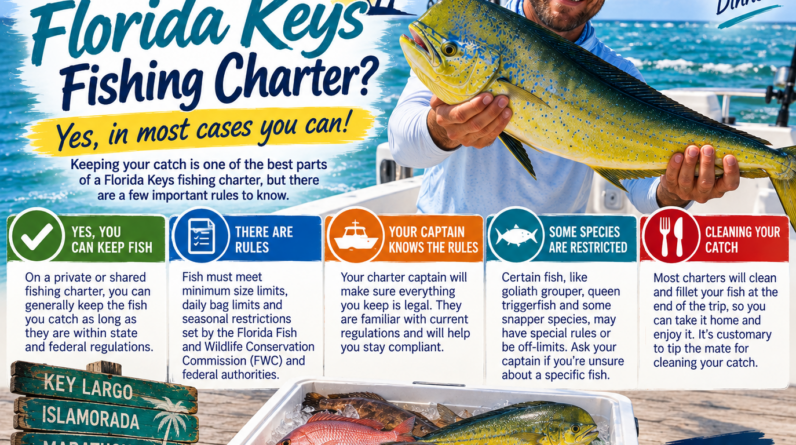
If you catch a legal-size fish during an open season and it falls within current bag and vessel limits, you may be able to keep it.
But not every fish caught on a Florida Keys fishing charter can go into the cooler.
Whether you can keep a fish depends on:
- Species
- Size
- Season
- Bag limit
- Vessel limit
- Where the fish was caught
- Whether you are in state or federal waters
- Current emergency closures or temporary rules
Some species are commonly kept when legal.
Others are heavily regulated.
And some, such as tarpon, are almost entirely catch-and-release.
That is why the simplest answer to “Can I keep the fish I catch on a Florida Keys charter?” is:
Yes, if the fish is legal to harvest at that time and location.
Your captain should know the rules that apply during your trip.
What Fish Can You Keep on a Florida Keys Fishing Charter?
Depending on season, size, location, and current regulations, charter anglers may be able to keep species such as:
- Yellowtail snapper
- Mangrove snapper
- Mutton snapper
- Mahi-mahi
- Wahoo
- Blackfin tuna
- King mackerel
- Certain grouper species
- Other legal food fish
Do not treat this as a list of fish you can automatically keep.
Florida saltwater regulations are species-specific and can change. FWC maintains separate regulations for snapper, grouper, dolphinfish, wahoo, tuna, mackerel, permit, sharks, and many other saltwater species.
Before keeping anything, your captain should confirm that the fish is legal.
Can You Keep Every Legal Fish You Catch?
No.
Even when a species is open to harvest, there may be limits on:
- How many each person can keep
- How many the entire boat can keep
- Minimum size
- Maximum size
- Slot size
- Fishing method
- Where the fish was caught
You may catch several legal-looking fish and still have to release some because the bag or vessel limit has already been reached.
What Is a Bag Limit?
A bag limit controls how many fish of a particular species an individual angler may legally harvest during a specified period, usually per day.
For example, if a species has a one-fish daily bag limit, catching five legal-size fish does not mean you can keep five.
Once your limit is reached, additional fish must be released.
What Is a Vessel Limit?
A vessel limit applies to the entire boat.
That can matter on fishing charters.
Even if several anglers are fishing, the total number of a certain species allowed aboard may be capped.
Permit provide a good example. In the Florida Keys Special Permit Zone, current rules allow one permit per harvester but no more than two per vessel when the season is open.
This is why you should let the captain keep track of the day’s legal catch.
What Is a Minimum Size Limit?
A minimum size rule means the fish has to reach a specified measurement before it can legally be kept.
Fish below that size must be released.
Different species may be measured using:
- Total length
- Fork length
- Other species-specific methods
Do not guess.
Captains normally carry measuring devices and know how the species should be measured.
What Is a Closed Season?
Some fish may only be harvested during certain parts of the year.
That means you can legally catch a fish but still be required to release it because the harvest season is closed.
Grouper are a good example of why checking current rules matters.
For state waters off Monroe County, which includes the Florida Keys, several Atlantic grouper species have seasonal closures. FWC’s current grouper rules also show that seasons differ by species.
Can You Keep Grouper on a Florida Keys Charter?
Sometimes.
It depends heavily on the species and time of year.
For example, current Florida rules for Monroe County show different seasons for gag, black, red, scamp, yellowfin, and other grouper species. Some grouper are closed during part of the year, while others have different bag and size requirements.
Gag grouper regulations changed during 2026, with recreational harvest in Atlantic state waters off Monroe County closing beginning August 2.
That is a good example of why an old blog post or fishing chart should never be your final source for harvest rules.
Always check the current FWC regulations.
Can You Keep Permit?
Sometimes.
The Florida Keys fall within the Special Permit Zone.
Current regulations for that zone include:
- 22-inch minimum fork length
- One permit per harvester
- No more than two per vessel
- Harvest closed April 1 through July 31
Permit harvest reopens August 1 under the current rules.
You can still target permit during the closure, but legal harvest is prohibited.
Can You Keep Tarpon?
Almost never.
Florida tarpon fishing is catch-and-release.
FWC allows the harvest or possession of one tarpon only when someone is pursuing a Florida state or world record and has the required tarpon tag.
Tarpon over 40 inches must remain in the water unless that limited record exception applies.
For the overwhelming majority of Florida Keys charter customers, a tarpon goes back into the water.
Can You Keep Bonefish?
Do not assume you can.
Bonefish are managed differently from common table fish such as snapper.
If bonefish are one of your targets, ask your guide about the current regulations and proper release practices.
Flats trips are often focused much more on the experience of catching the fish than bringing dinner home.
Can You Keep Mahi-Mahi?
Mahi-mahi, also called dolphinfish, can be harvested when current size, bag, vessel, and seasonal requirements are met.
They are one of the species many visiting offshore anglers hope to bring back to the dock.
But current regulations still apply.
Your captain should check the legal status of every fish before it goes into the cooler.
Can You Keep Snapper?
Many snapper species can be harvested when legal, which is one reason reef fishing is popular with visitors who want fish for dinner.
Possible catches include:
- Yellowtail snapper
- Mangrove snapper
- Mutton snapper
However, each species can have different size, bag, and seasonal rules.
Red snapper are a particularly strong example of why you should check the current rules instead of assuming all snapper are treated alike. Florida’s 2026 Atlantic recreational red snapper harvest operates under specific season rules and participation requirements.
Does the Captain Decide What You Can Keep?
The captain does not create the regulations.
But a professional captain should know which fish can legally be harvested during your trip.
They should also know:
- Current seasons
- Size limits
- Bag limits
- Vessel limits
- State and federal boundaries
- Species-specific rules
If the captain tells you a fish needs to go back, let it go.
State Waters vs. Federal Waters
This can make fishing regulations seem confusing.
Florida state waters generally extend from shore to 3 nautical miles into the Atlantic and 9 nautical miles into the Gulf.
Beyond that, federal fishing regulations may apply.
The Florida Keys create an additional wrinkle because Monroe County regulations can sometimes apply differently than rules elsewhere in Florida.
That is another reason charter customers benefit from fishing with someone who works these waters regularly.
Can Regulations Change During the Year?
Yes.
This is an important point.
Seasons and regulations are not always fixed years in advance.
Fishery managers can change:
- Season dates
- Harvest limits
- Closures
- Emergency rules
For example, FWC changed the 2026 gag grouper season in Atlantic state waters off Monroe County through an executive order.
Check regulations close to your actual fishing date.
Can the Captain Keep Fish Too?
Not always.
Some species have rules that prohibit charter captains and crew from counting fish toward their own personal bag limits while operating a for-hire trip.
For example, FWC’s current Atlantic grouper regulations prohibit for-hire captain and crew retention for certain grouper species.
That does not usually affect the customer’s legal limit directly, but it shows how detailed charter-fishing regulations can become.
What Happens to Fish You Keep?
Once a fish is legally harvested, it is typically placed in:
- Ice
- A fish box
- A cooler
- Another chilled storage area
Keeping fish cold helps preserve the quality of the meat.
Many charter boats are set up specifically for this.
Will the Charter Captain Clean Your Fish?
Many Florida Keys charter operations will clean or fillet legal fish after returning to the dock.
But this is not universal.
Ask before booking:
- Is fish cleaning included?
- Is there an extra charge?
- Does the captain clean them?
- Does a marina fish-cleaning service handle them?
- Do we need bags or a cooler afterward?
Knowing this before fishing day makes the trip home much easier.
Can You Take the Fish Back to Your Hotel?
Often, yes, assuming the hotel allows it and you have appropriate cold storage.
Ask your hotel before arriving with several bags of fish.
Some accommodations may provide:
- Freezers
- Refrigerators
- Fish storage
- Cleaning areas
Others may not want guests storing freshly caught fish.
Can You Take Your Fish to a Restaurant?
Some Florida Keys restaurants offer cook-your-catch service.
That usually means you bring properly cleaned legal fish and the restaurant prepares it for you.
Policies vary by restaurant.
Ask about:
- Minimum or maximum quantities
- Preparation options
- Price
- Whether reservations are required
- Whether the fish must already be filleted
Do not walk into a restaurant with an uncleaned fish and assume they will prepare it.
Can You Ship Fish Home?
Possibly.
Local seafood processors and shipping businesses may be able to:
- Vacuum seal fish
- Freeze it
- Pack it
- Ship it
Ask your charter captain for local recommendations.
Captains regularly work with visiting anglers and may know the easiest way to handle your catch.
Can You Fly Home With Fish?
Often, yes, but airline and security rules matter.
If you plan to fly with fish, check the current rules for:
- Your airline
- TSA
- Packaging
- Frozen food
- Dry ice if used
- Checked versus carry-on baggage
Do this before your fishing trip rather than trying to figure it out at the airport.
Should You Tell the Captain You Want to Keep Fish?
Yes.
This is one of the most useful things you can tell a captain before booking.
Say something like:
“We would really like to catch some legal fish to eat if possible.”
That may affect the recommended trip.
Someone who wants table fish might be better suited to:
- Reef fishing
- Snapper fishing
- Certain offshore trips
Someone whose dream is catching a tarpon may be booking a catch-and-release trip instead.
What If You Don’t Want to Keep Fish?
That is completely fine.
Tell the captain.
Many anglers prefer catch-and-release fishing even when harvest is legal.
If you do not plan to eat the fish, releasing legal fish may be the better choice.
Is Catch and Release Better?
That depends on your goals and the species.
For protected or closed species, release is required.
For legal food fish, keeping some fish for dinner can be part of the fishing experience.
There is no requirement that you keep every legal fish.
A good approach is to decide what you will actually eat and avoid keeping fish simply because the law allows it.
How Should Released Fish Be Handled?
Quick, careful handling can improve survival.
For reef fish, Florida requires specific release equipment aboard vessels, including dehooking devices and a descending device or venting tool rigged and ready for use.
Tarpon require particularly careful handling. FWC recommends minimizing handling, keeping large tarpon in the water, and releasing them quickly.
Your captain should handle release procedures appropriately.
Why Do Reef Fish Sometimes Need a Descending Device?
Fish brought rapidly from deep water can suffer from barotrauma caused by pressure changes.
Descending devices help return affected fish to deeper water.
Florida’s reef fish gear rules require vessels targeting reef fish to have a descending device or venting tool rigged and ready for use.
This matters when releasing grouper, snapper, and other deeper-water reef fish.
Does a Fishing License Let You Keep More Fish?
No.
Your fishing license and your harvest limits are separate things.
Having a license does not give you permission to exceed:
- Bag limits
- Vessel limits
- Size restrictions
- Seasonal closures
And if you are fishing aboard a properly licensed Florida Keys charter, you generally do not need your own recreational saltwater fishing license for that charter trip anyway.
Read our Do You Need a Fishing License on a Florida Keys Fishing Charter? guide for details.
Which Charter Is Best If You Want Fish for Dinner?
I would first look at reef and certain offshore charters.
Reef fishing can provide opportunities for species such as:
- Yellowtail snapper
- Mangrove snapper
- Mutton snapper
- Legal grouper when seasons allow
Offshore trips may provide opportunities for:
- Mahi-mahi
- Wahoo
- Tuna
- King mackerel
That does not mean these fish will always be available or legal to harvest.
Tell the captain your goal and let current conditions and regulations determine the trip.
Which Charter Is Better for Catch-and-Release Fishing?
Flats and backcountry trips can be excellent choices.
Possible sport-fishing targets include:
- Tarpon
- Bonefish
- Permit
- Barracuda
These trips may focus more on the challenge of finding, hooking, fighting, photographing, and releasing fish than filling a cooler.
Read our Offshore vs. Backcountry Fishing in the Florida Keys comparison if you are deciding between fishing styles.
Can Beginners Keep Fish?
Yes.
Your experience level does not affect whether you can keep a fish.
The fish simply needs to meet the current legal harvest requirements.
Your captain can help you:
- Identify the species
- Measure it
- Check the season
- Track limits
- Store the fish properly
If this is your first charter, read our Florida Keys Fishing Charters for Beginners guide.
Questions to Ask Before Booking
If bringing home fish matters to you, ask:
- What legal table fish are normally available during my dates?
- What type of charter would you recommend?
- Can we keep legal fish?
- Do you clean the fish?
- Is fish cleaning included?
- Do you provide bags and ice?
- Is there somewhere nearby to freeze fish?
- Do you know a local processor?
- Are there cook-your-catch restaurants nearby?
The captain should be able to help you plan.
Florida Keys Charter Catch Quick Guide
Fish You May Be Able to Keep
Depending on current regulations:
- Snapper
- Mahi-mahi
- Tuna
- Wahoo
- King mackerel
- Certain grouper species
- Other legal food fish
Fish That May Be Seasonally Closed
Examples can include:
- Grouper species
- Permit
- Red snapper
- Other seasonally managed fish
Fish Primarily Managed as Catch and Release
Tarpon are the clearest example.
Always check current regulations rather than relying on a general list.
Frequently Asked Questions About Keeping Fish on a Florida Keys Charter
Can you keep fish caught on a Florida Keys fishing charter?
Yes, if the species is legal to harvest, meets current size requirements, is in season, and falls within applicable bag and vessel limits.
Does the captain decide which fish can be kept?
The law determines what is legal, but your captain should know and apply the current regulations during the trip.
Can you keep tarpon?
Generally no. Florida tarpon fishing is catch-and-release except for the limited state or world record tarpon-tag exception.
Can you keep permit?
Permit may be harvested when the season is open and the fish meets applicable regulations. In the Florida Keys Special Permit Zone, harvest is closed April 1 through July 31.
Can you keep grouper?
Some grouper can be kept during open seasons when they meet current size and bag requirements. Seasons vary by species, and several regulations apply specifically to Monroe County waters.
Will a Florida Keys charter clean your fish?
Many do, but policies vary. Ask before booking.
Can you bring your catch to a restaurant?
Some Florida Keys restaurants offer cook-your-catch service. Call the restaurant first to confirm its policy.
Can you ship your catch home?
Local processors may be able to freeze, package, and ship fish. Ask your captain for recommendations.
Do you have to keep legal fish?
No. You can release a legal fish if you do not want to keep it.
Can you keep more fish because you are on a charter?
No. Fishing from a charter does not exempt you from size, bag, vessel, or seasonal harvest restrictions.
Plan Your Florida Keys Charter Around What You Want to Catch
If bringing home fish for dinner is part of the experience you want, tell the captain before you book.
That simple conversation can help you choose the right trip.
A reef charter might make sense if snapper are your priority.
An offshore charter may make more sense if you hope to catch mahi-mahi, tuna, or wahoo.
A tarpon or flats trip may be much more focused on catch-and-release fishing.
Check our Florida Keys Fishing Calendar to see which species may be available during your travel dates.
Then compare Key Largo Fishing Charters, Islamorada Fishing Charters, Marathon Fishing Charters, and Key West Fishing Charters.
And before heading to the dock, read What to Bring on a Florida Keys Fishing Charter.